Blog - Beyond the Hype

Beyond the Hype: Building Practical AI Systems for Your Small Business
Alright, let's talk about AI. I've been in this game for three decades, seen mainframes become PCs, the internet emerge from dial-up, and cloud computing transform everything. Every few years, a 'new' technology sweeps through, promising to revolutionize your business overnight. And every time, the same core truth holds: without solid systems and processes, the technology just adds complexity, not value.
I know you're busy. Your days are a blur of client calls, team management, and putting out fires. The thought of adding 'learn AI' to that list can feel overwhelming. You've got established ways of working, patterns that are so ingrained they're almost subconscious. Breaking those patterns, even for something beneficial, is genuinely hard. It's not a failure on your part; it's just human nature. My job isn't to sell you the latest shiny object; it's to help you navigate this landscape safely, pragmatically, and with a clear path to real, measurable returns. We'll focus on the foundational steps that truly make a difference, not the flashy headlines.
Which best describes your current approach to operational improvements?
A. We mostly rely on manual processes and established routines. 'If it ain't broke...' is our motto, even if it's slow.
B. We're open to new tools and ideas, but we need clear, low-risk ways to experiment and understand how they fit into our existing work.
C. We have well-documented processes and are actively looking for ways to integrate technology to automate specific, repetitive tasks.
Solutions by Implementation Level
Mastering ChatGPT for Research & Content Drafts
AI Literacy
Before you automate anything, you need to understand the fundamental capabilities of generative AI. ChatGPT, or similar large language models, is an incredibly powerful tool for summarizing information, drafting initial content, and brainstorming ideas. Think of it as a highly efficient research assistant and first-draft writer, freeing up your mental bandwidth for strategic thinking and final polish. This isn't about replacing your insights; it's about augmenting your capacity to gather and synthesize information much faster. The system here is about defining clear inputs (prompts) to get useful outputs.
Timeline: 2-4 hours to learn basics, ongoing 1-2 hours/week for practice
Cost: $20/month (ChatGPT Plus) + 3 hours setup/learning
ROI: Saves 5-10 hours/month on research, drafting, brainstorming. At $50/hour, that's $250-$500/month savings, easily 10x ROI.
Failure Rate:15% struggle with effective prompt engineering, leading to generic outputs. 5% abandon due to feeling overwhelmed.
Action Steps:
Sign up for ChatGPT Plus ($20/month) or a comparable service.
Start with simple tasks: 'Summarize this article on [topic]', 'Draft 3 subject lines for an email about [product/service]'.
Learn prompt engineering basics: Be specific, provide context, define desired output format (e.g., 'Act as a marketing expert...', 'Provide 5 bullet points...').
Use it for early-stage market research by summarizing public information and organizing data.
Recommended Tools:
Protective Warning:Don't blindly trust AI outputs. Always fact-check and apply your domain expertise. AI hallucinations are real. Never input sensitive or proprietary information without checking the tool's data privacy policy and understanding how your data will be used. This is a tool for drafting, not definitive answers.
Streamlining Content Creation with AI Writers
AI Literacy
Beyond general-purpose chatbots, specialized AI writing tools can significantly accelerate your content pipeline. If you regularly produce blog posts, ad copy, social media updates, or email newsletters, these tools can generate high-quality drafts based on your inputs. This isn't about replacing your unique voice, but rather about overcoming writer's block and creating a solid foundation much faster. The system here is about standardizing content briefs and leveraging AI to generate variations and optimize for different channels, ensuring consistency and speed.
Timeline:3-5 hours for initial setup and training, ongoing 2-3 hours/week for content generation.
Cost:$29-$99/month (Writesonic/Jasper) + 4 hours setup.
ROI:Saves 8-15 hours/month on content drafting and ideation. At $50/hour, that's $400-$750/month savings, easily 5x ROI.
Failure Rate:20% struggle to refine AI-generated content to match their brand voice. 10% find the output too generic without significant human editing.
Action Steps:
Choose a dedicated AI content tool like Writesonic.
Identify your most repetitive content tasks (e.g., social media captions, short blog intros, product descriptions).
Provide clear briefs to the AI, including keywords, tone, and target audience.
Review and heavily edit the AI's output to ensure it aligns with your brand's voice and accuracy.
Recommended Tools:
Protective Warning:AI-generated content often lacks nuance and genuine human connection. It's a starting point, not a finished product. Always review, edit, and inject your unique perspective. Avoid publishing unedited AI content – it can damage your brand's credibility and authenticity.
Basic AI-Assisted Task Automation for Solopreneurs & Small Teams
Foundation
Even without complex integrations, AI can automate mundane, repetitive tasks that eat away at your day. Think of it as offloading the 'digital grunt work.' Tools exist to help manage calendars, sort emails, transcribe calls, and handle basic data entry. This is about identifying those small, frustrating tasks you do daily or weekly and finding a simple, affordable AI solution to take them off your plate. The system here is about identifying the 'micro-processes' that can be automated and then documenting the new, streamlined workflow.
Timeline:4-8 hours for identifying tasks, tool research, and initial setup.
Cost:$10-$50/month per tool + 5 hours setup.
ROI:Saves 5-10 hours/month per automated task. At $50/hour, $250-$500/month for minimal cost, easily 5x ROI.
Failure Rate:25% struggle with initial setup or finding the right tool for their specific niche. 15% abandon due to lack of perceived immediate value or not clearly defining the task.
Action Steps:
List 3-5 of your most repetitive, low-value administrative tasks (e.g., scheduling, email triage, meeting notes).
Research tools designed for these specific tasks (e.g., AI-powered scheduling assistants, email sorters).
Start with one tool for one task. Document the old process, then the new process with the AI tool.
Monitor the time saved and adjust your workflow accordingly.
Recommended Tools:
Many AI calendar/email tools (e.g., Reclaim.ai, Superhuman with AI features)$10-$30/month
Otter.ai (for transcriptions)$0-$20/month
Protective Warning:Don't try to automate everything at once. Pick one or two pain points, solve them, and then move on. Over-automating without clear processes can lead to more confusion than efficiency. Ensure you understand how these tools handle your data, especially for meeting transcripts or emails.
Intelligent Workflow Automation with Zapier & AI Actions
Integration
Once you're comfortable with individual AI tools, the next step is to connect them into seamless workflows. This is where the real power of automation for small businesses shines. Tools like Zapier, combined with AI actions, can act as the 'glue' between your disparate systems. Imagine automatically drafting a personalized follow-up email after a CRM update, or summarizing customer feedback from a survey and pushing it to a project management tool. This requires a clear understanding of your existing processes and where data flows. It's about designing a system where AI augments your existing tech stack, not replaces it.
Timeline:8-16 hours for identifying workflows, designing 'Zaps,' and testing. Ongoing maintenance 1-2 hours/month.
Cost:$29-$99/month (Zapier) + 10 hours consultant help (optional but recommended for first integration).
ROI:Automates tasks saving 15-30 hours/month across multiple departments. At $50/hour, that's $750-$1500/month, easily 7x ROI.
Failure Rate:30% struggle with complex Zapier logic or integrating with niche apps. 20% experience 'broken Zaps' due to API changes or data inconsistencies. 10% underestimate the need for clear process documentation before automation.
Action Steps:
Document a specific, repetitive cross-application workflow (e.g., 'New Lead in CRM -> Draft Intro Email -> Create Task in Project Management'). Remember: Systems before technology!
Sign up for Zapier and explore its AI actions.
Build a simple 'Zap' connecting two tools, using an AI action (e.g., 'New email in Gmail -> Use ChatGPT to summarize -> Add summary to Slack channel').
Thoroughly test your automated workflow with real data before full deployment.
Consider integrating AI with platforms like WhatsApp or Slack for automated responses or summaries.
Recommended Tools:
ChatGPT API (integrated via Zapier)Usage-based, typically low
Protective Warning:Do not attempt to automate a broken or undocumented process. AI will only automate the 'brokenness' faster. Ensure robust error handling in your Zaps. Data privacy and security become even more critical when integrating multiple systems – understand what data is being shared between platforms. Start small, test rigorously, and scale gradually.
Real-World Example:Success
Business:Small Marketing Agency (5 employees)
Situation:Our agency was drowning in manual content creation for social media and basic client reports. Each client required unique content, and initial drafts took hours, bottlenecking our creative team. We also spent too much time summarizing competitor activities for strategy meetings.
Approach:Instead of hiring another junior writer, we implemented ChatGPT Plus for initial content drafts and market research summaries. We spent 2 weeks documenting our content brief process meticulously, then trained the team on prompt engineering . For client reports, we used an AI writing tool (like Writesonic) to generate initial bullet points and summaries from raw data. We started with low-stakes content first.
Result:Within 3 months, our content drafting time was reduced by 40%, freeing up our creative team for higher-value strategic work. Market research for new clients, which used to take a full day, was condensed to 2-3 hours. This directly translated to taking on 2 new clients without increasing headcount, generating an additional $10,000/month in revenue. Our $50/month investment yielded a 200x return.
Lesson:The key was documentation first. We didn't just throw AI at the problem; we defined exactly what we wanted to automate and how the AI would fit into our established content workflow. The human oversight and editing remained critical, ensuring brand voice and accuracy.
Systems Thinking Insight
After decades in IT, I've seen countless organizations try to bolt new technology onto old, undefined, or broken processes. It never works. What happens is the existing, deeply ingrained patterns of work simply absorb the new tool, often rendering it useless or even counterproductive. Your team, yourself included, has developed muscle memory for your current operations. That's not a flaw; it's a testament to consistency. But it also means that simply introducing an AI tool won't automatically change behavior or improve efficiency. The real power comes from understanding your current system – the steps, the decisions, the handoffs, the pain points – and then strategically applying technology.
You cannot automate what you haven't first documented. If you can't explain your process to a new hire, you certainly can't explain it to an AI. This isn't about rigid bureaucracy; it's about clarity. Clarity allows you to identify the specific bottlenecks where AI can deliver a surgical, high-ROI improvement, rather than a scattershot approach that just adds another layer of complexity. Remember, the goal is always to refine the system, and technology is just one lever to pull, not the entire engine.
Quick Wins Library
Document One Repetitive Task
Pick one administrative task you do weekly (e.g., 'how I create a social media post,' 'how I respond to common customer inquiry'). Write down every single step, no matter how small. This is your foundation.
Time: 30-60 minutes
Cost: Free
Impact: Uncovers potential automation points and clarifies your current process, saving future headaches.
Experiment with Basic Prompting
Spend 15 minutes with a free version of ChatGPT or Copilot. Ask it to 'Draft 5 ideas for a blog post about [your niche]' or 'Summarize the key points of [a recent article relevant to your business]'. Focus on being clear and specific in your request.
Time: 15-20 minutes
Cost: Free
Impact: Builds basic AI literacy and helps you understand its capabilities and limitations without commitment.
Identify One 'Low-Value' Time Sink
Reflect on your last week. What was a task you dreaded, found tedious, and felt didn't leverage your unique skills? This is a prime candidate for future AI assistance.
Time: 10 minutes
Cost: Free
Impact: Focuses your energy on high-impact areas for potential automation, preventing wasted effort.
Resource of the Day
Building AI Literacy Learning Path on LinkedIn Learning
Course
This structured learning path is an excellent starting point for anyone looking to understand how AI can integrate into their work. It helps you identify where AI can assist, boosting your productivity and innovation without needing to become a data scientist. It's a practical, foundational resource.

Guides
The Power of Early Validation
Prompt Engineering Basics
Plan First Guide to
No-code App Building
MVP App Platform Guide
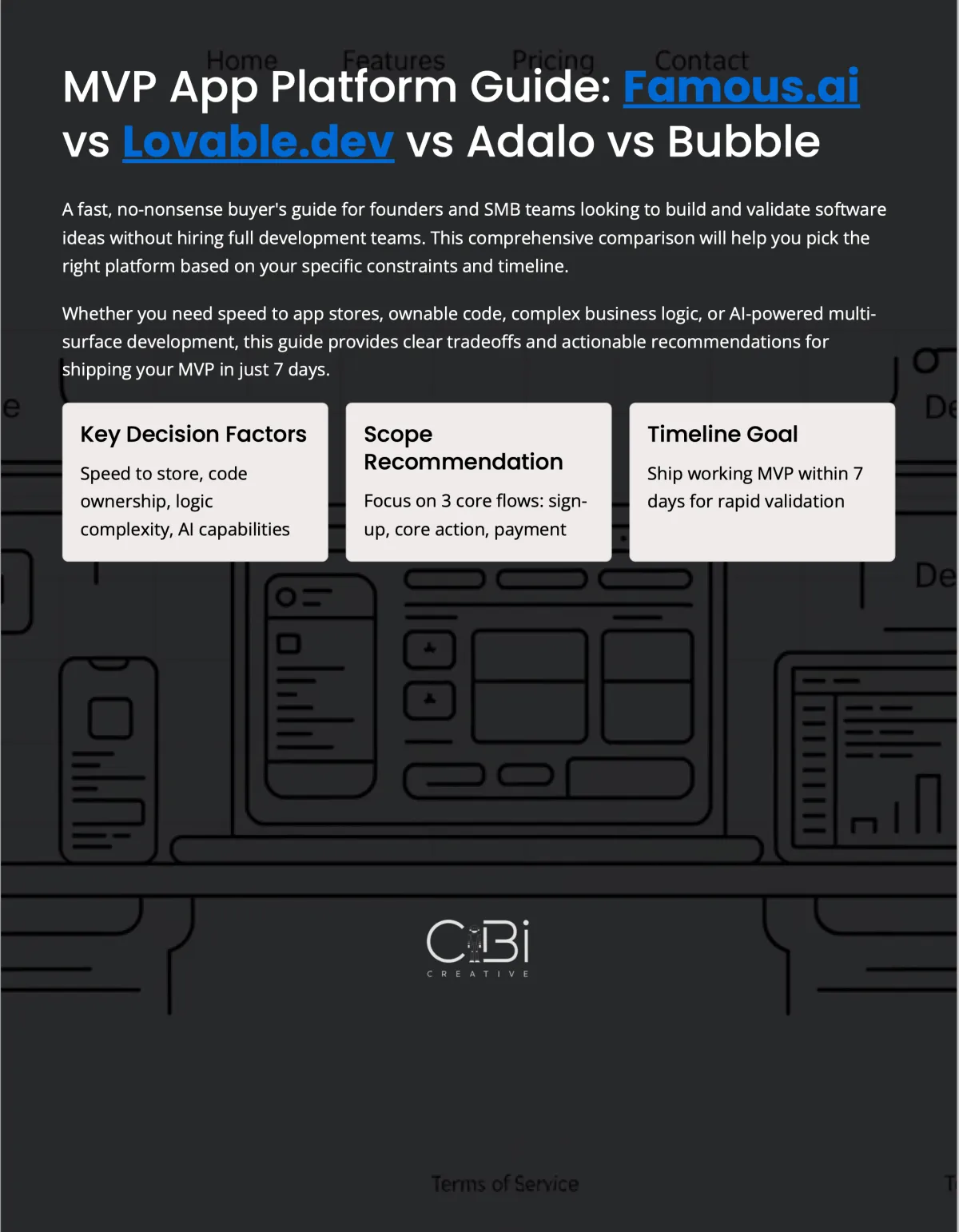
AI Tips, Traps and Tidbits
A collection of PDFs containing tips on using AI. Written for business coaches, consultants and SMBs interested in AI and no-code/low-code/vibe-code app builders.
Loading PDFs...


COPYRIGHT © 2025 CIBI CREATIVE - ALL RIGHTS RESERVED. WEBSITE BY CIBI CREATIVE
PRIVACY POLICY - TERMS AND CONDITIONS - AI USAGE POLICY